NEWNews articles
Reaching the Most Vulnerable through Innovative Investment Approaches - World Water Week Reflections
Reflections on World Water Week 2026 session
At World Water Week 2026 in Stockholm in August, Aqua for All hosted a session on ‘Reaching the most vulnerable through innovative investment approaches’ together with our partners.
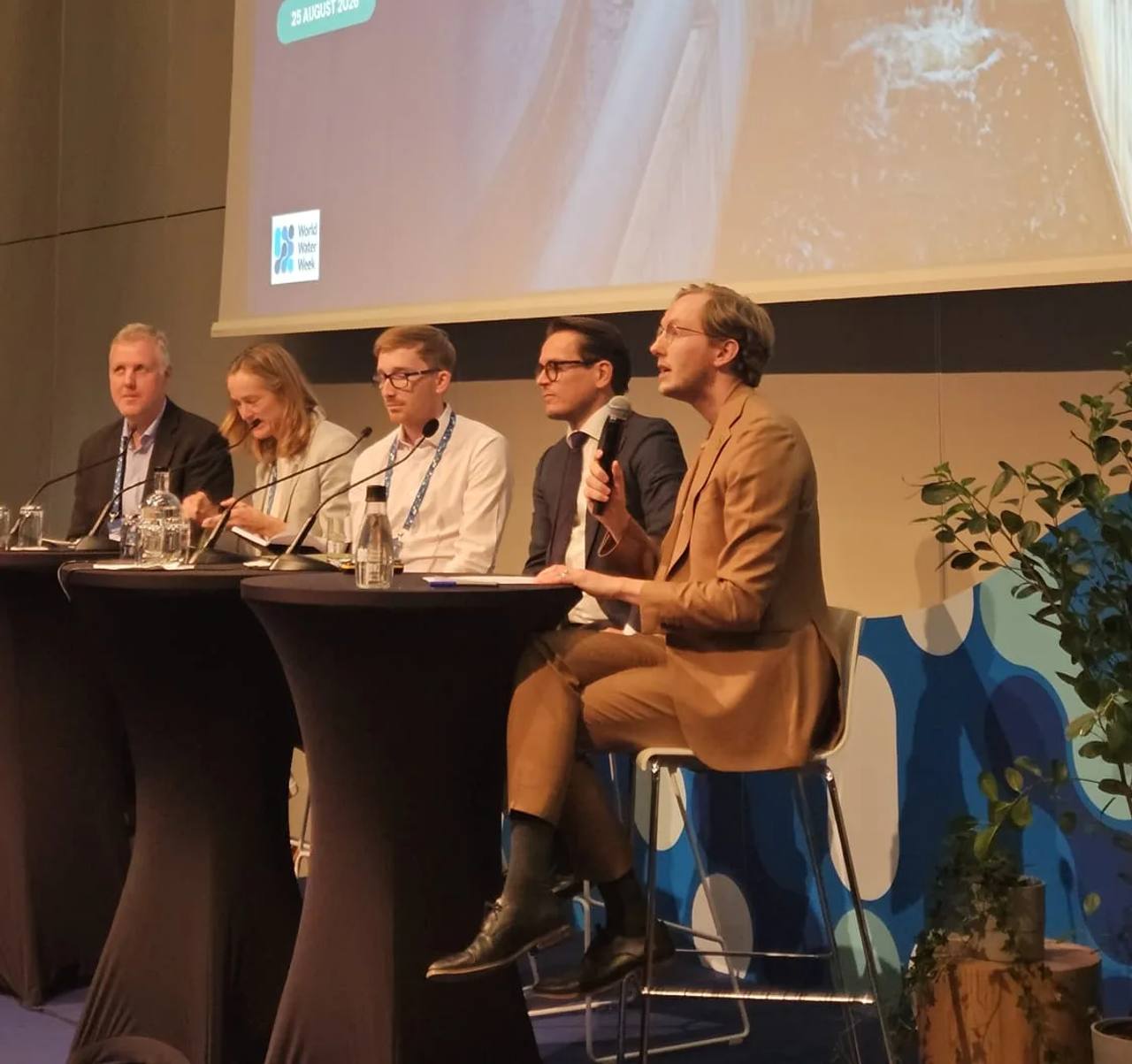
At World Water Week 2026 in Stockholm in August, Aqua for All hosted a session on ‘Reaching the most vulnerable through innovative investment approaches’ together with our partners, the Swiss Agency for Development and Cooperation (SDC), the Stone Family Foundation (SFF) and the Netherlands' Ministry of Foreign Affairs (MFA). Across two panels, senior leaders from across the water and sanitation sector discussed what it takes to mobilise investment that truly reaches the communities needing it the most.
A USD 141 Billion Financing Gap to Close
As government budgets supporting the sector remain limited, the discussion returned repeatedly to private capital. “We need to bring in the private sector to fill the water finance gap”, said Tim Evers, Lead Impact and Knowledge at Aqua for All. “There's just no other reality possible.” Yet even as private capital grows, it covers only 2% of the USD 141 billion needed each year to secure universal access to safe water and sanitation.
That reality also underlined a key point that emerged throughout the discussion: private capital alone cannot save the sector. It plays a complementary role alongside government, donor and philanthropic funding, not because those sources have failed, but because their resources are limited. Given the still modest role that private capital plays in sector financing, the challenge is not simply to increase its share, but to rethink how different sources of finance can work together. The rest of the panel explored what this looks like in practice.
Funding the full continuum
Growing the existing 2% is not simply a matter of adding more money to the sector. The challenge is to combine the right financing instruments at different stages of enterprise growth and market development, while using scarce grant funding strategically. As Evers put it, "Use as little grants as you possibly can because it's such a scarce resource." This reflects the OECD's principle of minimum concessionality: public funds should be used only to the extent needed to unlock capital or outcomes that the market would not deliver on its own.
Grants and the enabling environment
Eva Schreuder, Head of Water at the Ministry of Foreign Affairs of the Netherlands, advocated for a deliberate sequencing rather than a one-size-fits-all funding strategy. In the most marginalised areas, grants remain essential, for example, working through partners such as UNICEF, while in areas with greater market potential, funding should focus on building the investment readiness needed to access commercial finance. She pointed to a Kenyan bank whose domestic water lending expanded after targeted capacity-building, thereby freeing scarce public resources for places that still need them. Tariff design matters too, she added: allowing larger users to cross-subsidise lower-income households.
Bruce Campbell, Senior Policy Advisor at SDC, described public funding as a tool to reduce risk and create space for innovation. He was also honest about why SDC works through specialised partners: “Understanding private sector and business incentives is something that we as a state actor are notoriously bad at, which is exactly why we work with organisations like Aqua for All”. In return, businesses need predictable, long-term commitment of at least 5 to 10 years, he argued, as constantly shifting funding undermines incentives to invest and grow.
Blended and first-loss pilots
Ben Shergold, Investment Manager at SFF, described the foundation's more experimental pilots on the same principle: since some water providers spend 30% to 50% of revenues on energy bills, SFF combines grants for project preparation with first-loss and concessional capital to attract investors who would otherwise see these providers as too risky to back.
On lending and fund-level first-loss
Evers described a model already operating at scale: Aqua for All uses grant funding to unlock lending from microfinance institutions (MFIs) and banks. In Ethiopia, this approach now runs three layers deep: a commercial bank lends to MFIs, which in turn finance water enterprises and small operators serving rural areas that would otherwise have no access to capital.
At fund level, Aqua for All applies the same logic through a different mechanism: a small share of its grant funding, typically the first 5%, absorbs the first losses inside larger fund structures, enabling commercial banks and development finance institutions (DFIs) to provide senior capital behind it. “By using one million, you can leverage 80 million, sometimes more”, Evers said. Such funds rarely reach the most vulnerable directly, since they still need to generate a return. However, by scaling enterprises and mobilising additional capital, they free up scarce grant funding for the earliest-stage providers, underserved communities, and other areas that no commercial investor would support on its own.
Examples from the ground: impact-linked finance
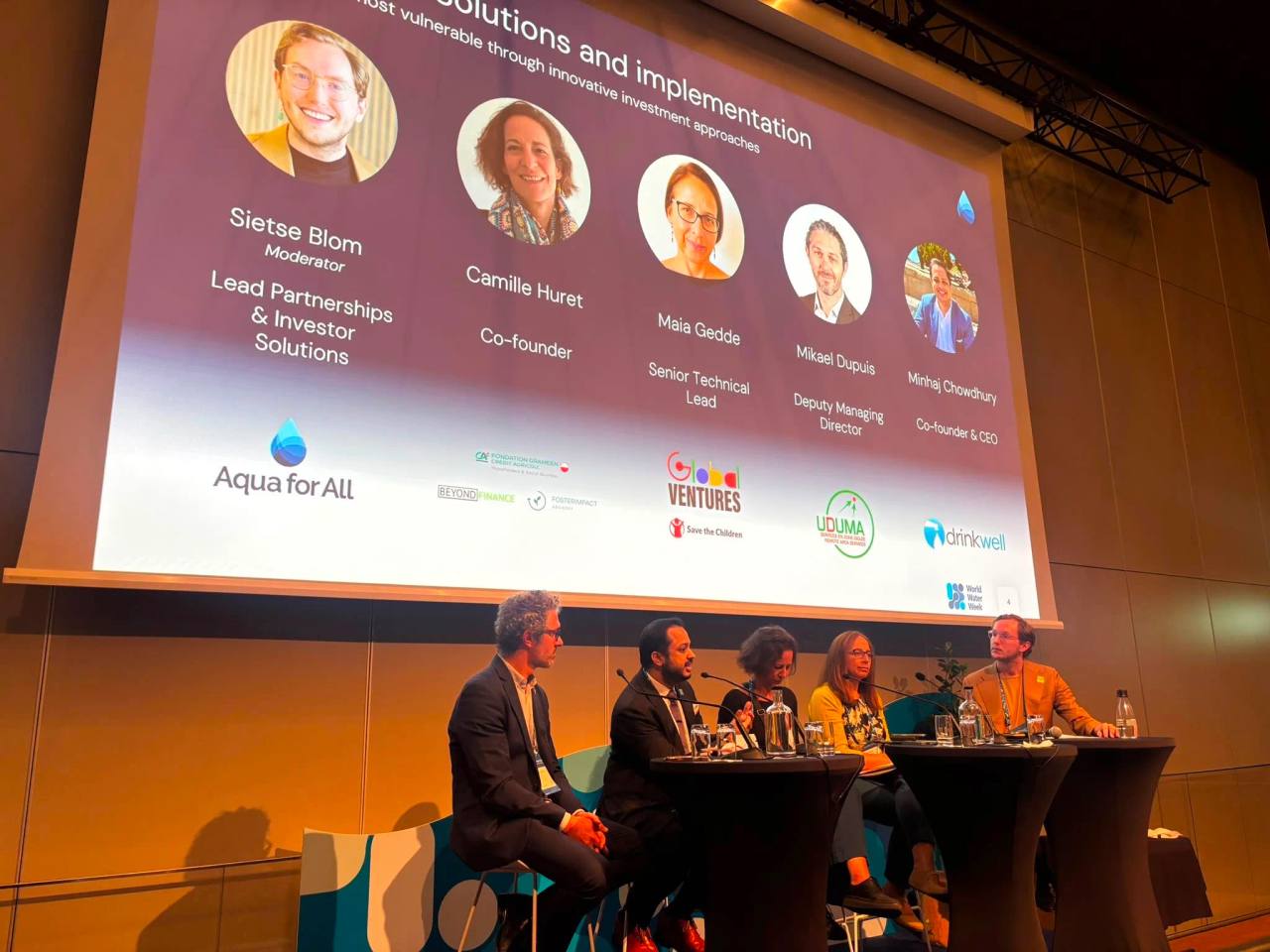
Minhaj Chowdhury, Co-founder and Chief Executive of Drinkwell, showed what that calibration looks like at scale. Drinkwell partners with Bangladeshi utilities to install decentralised water ATMs where piped networks do not reach, thereby cost-sharing the housing and connection while Drinkwell supplies the equipment. The model grew from diaspora philanthropy into blended grant and sovereign-loan financing from, among others, the Asian Development Bank, which bridged the years before piped systems arrived. It now runs 330 ATMs across every utility in Bangladesh, reaching 3 million people with 40 million litres of clean water a month. Its Social Impact Incentive (SIINC), an outcome-based finance mechanism with Aqua for All, pays 30 cents for every commercial dollar the enterprise raises, tied to verified outcomes that specifically reward reaching harder-to-sell, harder-to-reach customers.
According to Maia Gedde, Senior Technical Lead at Global Ventures, a similar logic underpins the Generation Empowerment Fund: a USD 100 million education fund where schools that take commercial loans earn an interest-rate reduction for meeting water and sanitation targets; an incentive built into the lending itself rather than layered on top as a separate grant.
Calibrated this precisely, the continuum can look like the solution already. The panel's own experience said otherwise: in practice, markets and mandates are rarely this neat.
Market and mandate realities
Asked what stood in their way, each panellist pointed to a different barrier. For some, reaching the customers a market would otherwise overlook, whether through de-risking, targeted grants, or paying for outcomes, comes at a direct cost. For others, it means confronting limits no amount of financial engineering can remove.
For Schreuder, it is replicability: a model proven in Kenya or Senegal will not automatically work in Mali or Niger. For Campbell, it is a shift in what public money now funds: “We're not funding projects, we're funding business plans”, a shift philanthropic instruments are not always built for, compounded by funders who are inherently risk-averse and justify every decision to taxpayers.
For Shergold, the lesson came from the pilots themselves: being too prescriptive about which customers a provider should serve backfires. “What that leads to is that the private sector will focus on this as a one-time grant project rather than looking at it as a long-term opportunity”. The challenge is striking the right balance: enough direction to ensure real impact, enough flexibility for providers to build a business that lasts. Impact that is not built into the incentive itself, he found, tends to disappear once the incentive does.
Mikael Dupuis, Deputy Managing Director at Uduma, offered the sharpest counterpoint. Uduma runs water services under affermage contracts across three West African countries, serving 1.5 million people, without ever distinguishing vulnerable from non-vulnerable customers. Identifying who is vulnerable, he argued, is itself complicated and costly. Instead, Uduma prices tariffs to generate a margin, channelled through the local municipality, which he says is far better placed than any operator to identify and support those most in need. “The best way to reach the vulnerable is not to specifically focus only on the vulnerable”, he said.
The audience raised a related concern: results-based finance, for all its strengths, can reward whatever is easiest to measure rather than what matters most. This is why affordability was left out of the Sustainable Development Goal 6 (SDG6) indicators in the first place; it proved too hard to measure consistently. Chowdhury pointed to a workaround: Aqua for All and a Kenyan enterprise now use Meta's wealth index, built originally for advertising, as a proxy for income where no better data exists.
Camille Huret, Co-founder of Lift, raised a different constraint from the investor's side. The scarcest resource is not funding but investable enterprises ready to absorb it, particularly in what she called the 'missing middle' of roughly USD 1 million to USD 10 million in financing needs. This is a band too small for most funds and too large for most grants, and a space where enterprises simply lack the networks to find patient capital. Taken together, these examples highlight that delivering impact has often less to do with finding the perfect instrument than with adapting to the realities on the ground.
No single instrument reaches everyone
Because every instrument carries its own cost, the panel's conclusion was not a single best mechanism but a coordinated set of them, each absorbing a different part of the problem. Put to the audience twice by live poll, results-based financing remained the room's favourite, but the more consistent message, echoed from grants to first-loss capital to impact-linked finance, was that multiple instruments are needed together: grants where markets are furthest away, concessional capital and technical assistance to prepare enterprises for investment, local banks and MFIs to extend reach, and blended structures to bring in the commercial and institutional capital the sector has sought for over a decade.
Mobilising more private capital matters. But reaching the most vulnerable depends less on how much capital shows up than on how precisely it is calibrated and combined with the public and philanthropic funding that remains scarce.
Note: This recap draws on the recorded session (World Water Week 2026, Stockholm) and a transcript of the public recording. Quotations are lightly edited for clarity; their substance is unchanged from what was said on the panel.
Would you like to know more about our attendance at World Water Week? Please see the article here.
Latest stories
View all News articles
 News articles
Water Access Acceleration Fund featured in UN Global Compact blended finance playbook
Aqua for All’s collaboration with partners on the Water Access Acceleration Fund (W2AF) has been featured in Business-Led Blended Finance: A Practical Playbook, published by the CFO Coalition for the SDGs of the UN…
Read more News articles
Aqua for All and Conrad N. Hilton Foundation expand their strategic partnership to advance water and sanitation finance in Ethiopia
Aqua for All, in partnership with the Conrad N. Hilton Foundation, is expanding their long-term strategic partnership of the Advancing Water and Sanitation Finance in Ethiopia and Beyond programme.
Read more